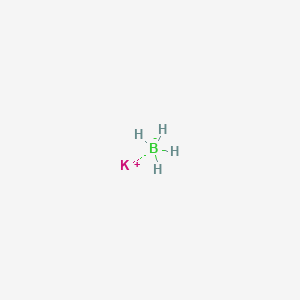
Potassium Borohydride
Potassium Borohydride (KBH4, CAS 13762-19-1), min. 97.0%, supplied wholesale by Zyntex for professional use. Stable, selective reducing agent for pharmaceutical synthesis, hydride generation analysis and electroless plating. CoA and SDS.
Description
Potassium Borohydride Product Overview
Potassium borohydride (KBH4) is a white crystalline powder. Compared with sodium borohydride, it absorbs less moisture and is more stable in air, which makes storage and handling easier. It dissolves in water and slowly decomposes there, releasing hydrogen; alkaline solutions are much more stable.
Chemists use it to reduce aldehydes and ketones to alcohols selectively in the presence of esters and other functional groups, which is common in the synthesis of pharmaceutical intermediates. Combined with Cerium Chloride Heptahydrate, borohydrides give the selective Luche reduction. In analytical laboratories, it generates hydrides of arsenic, selenium and other elements for atomic absorption and fluorescence spectroscopy.
Other uses include electroless plating and the production of other boron hydrides. For related boron compounds, see Lithium Borohydride and Boric Acid.
Key Applications of Potassium Borohydride
Main application areas:
💊 Pharmaceutical Synthesis
Selective reduction of carbonyl compounds.
🔬 Analytical Chemistry
Hydride generation for AAS and AFS.
⚡ Electroless Plating
Reducing agent in plating baths.
🧪 Boron Chemistry
Starting material for other boron hydrides.
Potassium Borohydride Technical Specifications
| Parameter | Standard Value |
|---|---|
| Product Name | Potassium Borohydride |
| CAS Number | 13762-19-1 |
| EC Number | 237-360-5 |
| Molecular Formula / Weight | KBH4 / 53.94 g/mol |
| Assay / Purity (Titration) | Min 97.0% |
| Appearance | White or almost white crystalline powder |
| Density | 1.17 g/cm3 |
| Solubility | Soluble in water (slow decomposition); soluble in liquid ammonia; insoluble in ether |
| Documents | CoA and SDS with every lot |
⚠️ Safety & Handling: In contact with water or acids it releases flammable hydrogen gas. Toxic if swallowed or in contact with skin, causes severe skin burns and eye damage, and may damage fertility. For professional use only. Keep dry and away from acids, water and ignition sources; handle under dry conditions with gloves, goggles and protective clothing. Always consult the Safety Data Sheet (SDS) for full classification and handling instructions.
Frequently Asked Questions
What is the difference between potassium and sodium borohydride?
Both are similar reducing agents. Potassium borohydride is less hygroscopic and more stable in air, while sodium borohydride is more soluble in some organic solvents.
How should potassium borohydride be stored?
Keep it in tightly closed containers in a cool, dry place, away from water, acids and oxidizers, because it releases hydrogen on contact with moisture.
How can I get a price and documents?
Prices depend on quantity, packaging and destination. Contact us with your required volume to receive a quotation together with the CoA and SDS.