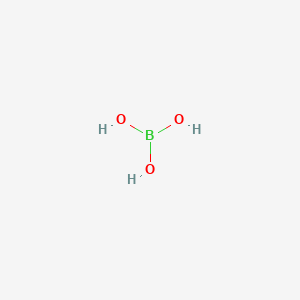
Boric Acid

Boric Acid is a premium-grade, white crystalline powder weak inorganic Lewis acid compound carrying CAS number 10043-35-3. Processed under strict industrial quality compliance, this high-purity metallurgical active substance exhibits exceptional thermal expanding resistance and reliable chemical matrix stability. Therefore, it is an ideal core choice for manufacturing specialized textile fiberglass, advanced technical ceramic glazes, and modern flame-retardant industrial formulation lines globally.

SKU: 10043-35-3 Category: Tags: ,
Description
Boric Acid represents an elite-grade inorganic hydrogen borate substance refined under strict molecular quality guidelines. This compound fulfills advanced vitreous ceramic compounding and industrial chemical buffer standards.
Zyntex supplies high-purity Boric Acid (CAS 10043-35-3) tailored for global manufacturing plants. It is ideal for insulation fiberglass factories, optoelectronic glass laboratories, and international polymer flame retardant loops.
Functioning as a highly specific vitreous network former, it regulates chemical bath pH stabilization. Furthermore, it delivers precise substance profiles that ensure uniform dry batch integration. Its strictly minimized sulfate trace impurities and optimized granular particle geometry make it an ideal selection. **Consequently**, it fits sensitive metallurgical flux formulations and continuous electroplating industrial production perfectly. Accordingly, formulation engineers specify this active substance to stabilize modern borate carriers. This practice maintains exact structural integrity across continuous processing cycles.

Vitreous Network Cross-Linking Efficiency

Excellent crystalline solubility performance and outstanding molten silica binding affinity provide a distinct operational edge. This advantage is crucial when engineering modern fast-sintering technical glass formulations. This active inorganic solid operates by facilitating the uniform cross-linking of microscopic boron-oxygen tetrahedral structures. **Thus**, it successfully lowers the thermal expansion index of glass substrates. It supplies the exact chemical mechanisms required to induce rapid thermal shock resistance. As a consequence, it does this without altering raw batch uniformity.

It assists processing engineers in maintaining strict boron concentration uniformity. This balance is critical across high-speed rotary kiln operations and continuous glass fiber extrusion lines. **Hence**, it mitigates trace sedimentation risks within automated volumetric feeding systems. For instance, specialized manufacturing facilities incorporate this refined Lewis acid powder. It acts as a core active component in targeted borosilicate laboratory glassware production cycles. Consequently, it maximizes the technical throughput of automated pressurized glass blowing machinery. Consequently, Zyntex coordinates clean room synthesis paths to eliminate downstream moisture-induced clumping from your factory schedule.

Thermal Matrix Homogeneity and Logistics

In addition to this, Zyntex coordinates climate-controlled logistics for pilot-scale manufacturing operations and advanced flame-retardant formulation centers. This service supports advanced flame-retardant formulation centers globally. The compound maintains its refined trihydroboron geometry under strict storage parameters. **Therefore**, it prevents temperature-induced degradation or structural caking during automated mechanical blending steps. It advances contemporary chemical engineering by providing a thoroughly analyzed, highly predictable inorganic raw material. This product fully meets international industrial purity monographs.

Simultaneously, it remains a critical chemical standard for routine acid-base titration calibration assays. It also supports inductively coupled plasma (ICP-OES) elemental validation testing loops. In brief, our product functions as a dependable chemical foundation. It successfully supports both the performance of commercial industrial batches and the analytical rigor of specialized industrial laboratories.

Primary Industrial Sectors for Boric Acid

This high-purity crystalline active inorganic compound delivers crucial technical value within these four primary industrial sectors:

🧵 Fiberglass Insulation

Primary boron hammadde source used for lowering melt temperatures. It successfully increases the mechanical tensile strength of textile glass fibers. Hence, it directly supports optimal structural control lines.

🏺 Ceramic Glazes

Utilized as a professional glass-forming flux to compound high-brilliance vitreous tile overlays. It supports sanitaryware borders and refractory linings. Clearly, it is key for uniform dissolving patterns.

🔥 Flame Retardants

Acts as an essential active cellulosics coating standard. It fits manufacturing specialized fire-resistant insulation materials and technical wood finishes. Resultantly, it guarantees excellent matrix clarity.

🧪 Technical Buffers

Used as a professional high-purity weak acid component. It validates advanced nickel electroplating baths and specialized swimming pool water treatments. Specifically, it confirms optimal reaction pathways.

Technical Specifications

ParameterStandard Value
Product NameBoric Acid (Orthoboric Acid / Hydrogen Borate)
Assay / Purity (H3BO3)Min 99.5% (Industrial Pure Grade)
AppearanceWhite granular or crystalline powder
Sulfate (SO4) ImpurityMax 0.1%
Density1.435 g/cm³
CAS Number10043-35-3

⚠️ Safety & Handling (REPRODUCTIVE RISKS / INDUSTRIAL DUST IRRITANT): Boric Acid is a highly stable, non-flammable inorganic compound showing predictable physical properties. However, intense continuous airborne inhalation of raw powder dust clouds triggers moderate occupational respiratory membrane tract irritation. Excessive systemic absorption over prolonged phases poses serious reproductive developmental toxicity and embryo hazards. Therefore, store comfortably inside original moisture-resistant tightly sealed protective container bags. Keep it situated within a cool, thoroughly dry, and standard cross-ventilated commercial raw material warehouse. Always store it away from volatile water sources and heavy alkalizing agents. Keep packaging tightly closed when not actively dispensing to avoid physical lumping. Standard good industrial handling practices are completely sufficient to sustain absolute personal safety. These include basic clean room processing gloves, safety eyewear, and a mechanical particulate filter dust protective mask. Review the Safety Data Sheet (SDS).