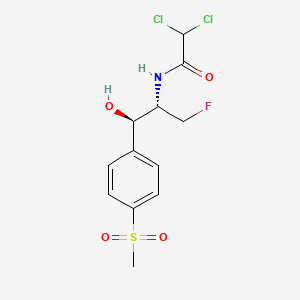
Florfenicol
Florfenicol is a broad-spectrum, fluorinated synthetic analog of thiamphenicol. Researchers utilize this API to study the blockade of bacterial protein synthesis and its efficacy against acetyltransferase-mediated resistance.
Description
Comprehensive Product Overview
In the field of veterinary medicine, the ability to bypass common resistance enzymes defines the clinical longevity of antibacterial agents. Specifically, Florfenicol functions by binding to the 50S ribosomal subunit, thereby inhibiting peptidyl transferase and preventing bacterial protein synthesis. Additionally, researchers select this molecule because the substitution of a fluorine atom for the hydroxyl group found in chloramphenicol renders it resistant to inactivation by bacterial chloramphenicol acetyltransferase (CAT). Therefore, whether you investigate Pasteurella multocida or Aeromonas salmonicida, this API delivers reliable pharmacological support across various laboratory conditions.
Zyntex maintains a transparent production chain to ensure a precise impurity profile for every batch, focusing on the limitation of residual solvents and heavy metals. Moreover, our quality control team verifies every lot for solubility in organic solvents and moisture content to ensure the stability of injectable and premix formulations. For instance, we optimize the purity profile to support the development of long-acting injectable solutions used in bovine respiratory disease research. As a result, your lab receives a high-purity reagent for advanced studies into the pharmacokinetics of tissue distribution and the prevention of infectious pododermatitis.
Modern veterinary science relies on high-quality phenicol analogs to address the rising challenge of antimicrobial resistance in aquaculture and swine production. Because Florfenicol possesses a documented high level of bioavailability and rapid absorption, it remains a primary focus for studies involving oral medication through feed and water. Ultimately, Zyntex provides a dependable foundation for your next innovation in animal welfare and specialized pharmaceutical engineering.
Specialized Veterinary Applications
This high-potency fluorinated antibiotic is vital for the following research and production sectors:
🐄 Livestock Respiratory Care
Scientists use Florfenicol to investigate the treatment of Bovine Respiratory Disease (BRD) associated with Mannheimia haemolytica.
🐟 Aquaculture Pathology
Researchers include this API in protocols focused on controlling furunculosis and enteric septicemia in salmonid and catfish species.
🧬 Protein Synthesis Inhibition
Biotechnicians utilize this molecule to study the blockade of peptide bond formation in multi-drug resistant Gram-negative bacteria.
💊 Formulation Development
This compound serves as a core reactant for engineering stable injectable dosages and high-performance medicated feed additives.
Technical Specifications
| Parameter | Specification Standard |
|---|---|
| Product Name | Florfenicol (CAS 73231-34-2) |
| Molecular Formula | C12H14Cl2FNO4S |
| Purity | USP / BP Grade (Min. 98%) |
| Appearance | White to off-white crystalline powder |
| Solubility | Slightly soluble in Water; soluble in Ethanol and Methanol |
🔬 Scientific Data: For detailed antimicrobial spectrum, resistance patterns, and chemical profiling, consult: PubChem Entry: Florfenicol (External Link)