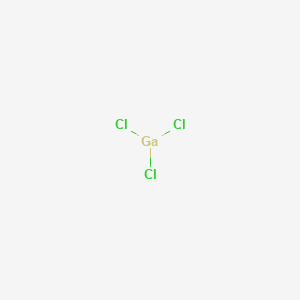
Gallium(III) Chloride
Anhydrous Gallium(III) Chloride (GaCl3, CAS 13450-90-3), 99.9–99.999%, supplied wholesale by Zyntex. Strong Lewis acid catalyst and precursor for GaN and Ga2O3 deposition and organogallium chemistry. CoA and SDS with every lot.
Description
Gallium(III) Chloride Product Overview
Gallium(III) chloride (GaCl3) forms colorless to white, deliquescent crystals that melt at about 78°C. It fumes in moist air and reacts violently with water, so it requires handling under dry, inert conditions.
In addition, chemists use it as a strong yet selective Lewis acid catalyst for Friedel–Crafts reactions, cyclizations and other transformations. Similarly, semiconductor researchers use high-purity gallium chloride as a precursor in vapor-phase deposition of gallium nitride and gallium oxide layers. It also serves as a starting material for organogallium compounds.
In addition, gallium chloride solutions have a notable history in physics: large tanks of them served as solar neutrino detectors. Related gallium materials in our range also include Gallium Metal and Gallium(III) oxide.
Key Applications of Gallium(III) Chloride
Typical uses include, for example:
⚗️ Lewis Acid Catalysis
Catalyst for Friedel–Crafts as well as cyclization reactions.
💡 Semiconductor Deposition
Precursor for GaN as well as Ga2O3 layers.
🧪 Organogallium Chemistry
Starting material for gallium compounds.
🔬 Research
High-purity reagent for laboratories.
Gallium(III) Chloride Technical Specifications
| Parameter | Standard Value |
|---|---|
| Product Name | Gallium(III) Chloride |
| CAS Number | 13450-90-3 |
| Molecular Formula / Weight | GaCl3 / 176.08 g/mol |
| Purity | 99.9% – 99.999% (Anhydrous) |
| Melting Point | 77.9°C |
| Appearance | Colorless to White Deliquescent Crystals |
| Documents | CoA as well as SDS with every lot |
⚠️ Safety & Handling: Causes severe skin burns and eye damage and reacts violently with water, releasing hydrogen chloride. Handle only under dry inert gas in a fume hood or glovebox, and also wear chemical-resistant gloves and face protection. Store in sealed ampoules or containers under argon, away from moisture. Always consult the Safety Data Sheet (SDS), because it contains the full classification and handling instructions.
Frequently Asked Questions
How is gallium chloride packed?
It ships in sealed glass ampoules or inert-gas containers, because moisture decomposes it immediately.
Which purity is needed for semiconductor work?
Semiconductor deposition usually requires 99.999% material, whereas synthesis often uses 99.9%.
How can I get a price and documents?
Prices depend on quantity, packaging and destination, so please contact us with your required volume. We then send a quotation together with the CoA and SDS.