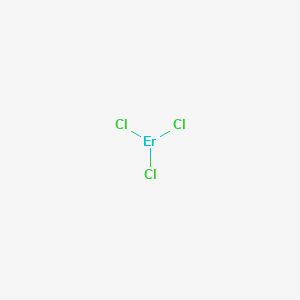
Erbium Chloride
Erbium chloride is a premium-grade, highly hygroscopic pink crystalline powder carrying CAS number 10138-41-7 (or 10025-75-9 for hexahydrate). Distinguished by its exceptional photoluminescent efficiency, narrow emission bands, and superior structural purity, this rare earth halide serves as an indispensable core dopant for manufacturing fiber optic amplifiers, solid-state laser crystals, and high-performance phosphors globally.
Description
Photoluminescent Dynamics and Laser Engineering
The narrow infrared emission spectrum and rapid water solubility profiles of Erbium chloride offer a distinct operational edge in demanding optical and high-tech defense manufacturing facilities. This solid lanthanide salt functions as a superior structural dopant, inserting active erbium centers into glass matrices without disrupting underlying glass density profiles. It assists manufacturing technicians in maintaining exact atomic concentration thresholds across continuous fiber co-deposition runs, effectively extending laser transmission clarity and preventing premature signal attenuation over long distances. For instance, advanced optical fiber facilities integrate this compound as their primary raw material to engineer erbium-doped fiber amplifiers (EDFAs). As a consequence, it maximizes the data capacity of submarine internet cables and improves automated signal routing tolerances. Consequently, Zyntex coordinates dust-free clean milling streams to eliminate purity-driven absorption losses from your manufacturing routine.
In addition to this, Zyntex manages hermetically vacuum-sealed logistics for high-precision scientific glassworks and specialized upconversion phosphor research laboratories. The substance operates as an active fluorescent promoter, coordinating effectively within organic polymer matrices to generate vivid green and red luminescent emission under infrared laser excitation cycles. It advances modern material engineering by providing a highly pure, dependable erbium source that reacts predictably during co-precipitation synthesis paths. Simultaneously, it remains a critical chemical reagent for routine spectroscopic calibration standards and academic academic diagnostics. In brief, our product functions as an indispensable mineral platform, supporting both the transmission reliability of transoceanic data networks and the technical precision of modern medical surgical lasers.
Primary Commercial Sectors for Erbium Chloride
This ultra-pure rare earth halide powder delivers crucial technical value within these four critical sectors:
🌐 Fiber Optic Amplifiers
Essential core dopant utilized to manufacture high-gain EDFA devices. Hence, it directly supports the distortion-free boosting of global optical data signals.
⚡ Solid-State Lasers
Serves as an active crystal precursor for medical, dental, and military-grade Er:YAG lasers. Clearly, it is key for achieving precise wavelength metrics.
🧪 Phosphor Production
Functions as a reliable structural block inside modern infrared upconversion fluorescent dyes. Resultantly, it balances long-term display durability.
🔬 Laboratory Research
Provides an excellent, highly pure source of trivalent erbium ions for academic chemical analysis and solid doping tests. Specifically, it ensures high tracking pathways.
Technical Specifications
| Parameter | Standard Value |
|---|---|
| Product Name | Erbium chloride |
| Assay / REO Purity (Er2O3/TREO) | Min 99.9% to 99.999% |
| Appearance | Pink hygroscopic crystalline aggregates or powder |
| Melting Point | Approx. 774 °C (Anhydrous) |
| Solubility in Water | Highly soluble in water and polar mineral acids |
| CAS Number | 10138-41-7 (Anhydrous) / 10025-75-9 (Hexahydrate) |
📝 Safety & Handling: Erbium chloride is a stable, non-flammable rare earth metal halide. Due to its intense hygroscopic tendencies, it rapidly absorbs ambient vapor moisture, which can cause chemical clumping and mild surface thermal reactions during hydration. Inhalation of crystal fine powder triggers mechanical eye itching, throat scratchiness, and upper respiratory tract irritation. Therefore, store strictly within its original moisture-tight, vacuum-sealed industrial packaging inside a climate-regulated, dark, completely dry warehouse zone away from aqueous fluids and ambient humidity. Avoid exposing open powder during transfer runs. Wearing essential personal protective equipment (PPE)—including protective nitrile gloves, dust safety glasses, and a certified particulate mask—is highly recommended during material compounding. Review the Safety Data Sheet (SDS) for routine plant containment rules.