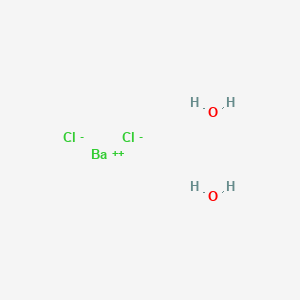
Barium Chloride 2-Hydrate
Barium Chloride Dihydrate (CAS 10326-27-9), min. 99%, supplied wholesale by Zyntex for professional use. Water-soluble barium salt for brine sulfate removal, laboratory sulfate testing, pigments and barium chemicals. CoA and SDS.
Description
Barium Chloride Dihydrate Product Overview
Barium chloride dihydrate (BaCl2·2H2O) is a white crystalline powder that dissolves freely in water and gives a neutral solution with a pH of about 5–8. Compared with Barium chloride in anhydrous form, it is easier to dissolve and handle in aqueous processes.
Chlor-alkali and salt producers use it to remove sulfate from brine, because barium sulfate precipitates and can be filtered off. Similarly, laboratories use it as the standard reagent for detecting sulfate, and pigment producers use it to make barium-based pigments such as Barium sulfate. It also serves as a starting material for other barium compounds.
Soluble barium compounds are toxic if swallowed, so Zyntex supplies it for professional use. Related barium compounds in our range also include Barium carbonate.
Key Applications of Barium Chloride Dihydrate
Typical uses include, for example:
💧 Brine Purification
Sulfate removal in chlor-alkali plants.
🔬 Laboratory
Reagent for sulfate testing.
🎨 Pigments
Raw material for barium pigments.
🧪 Barium Chemicals
Starting material for barium compounds.
Barium Chloride Dihydrate Technical Specifications
| Parameter | Standard Value |
|---|---|
| Product Name | Barium Chloride Dihydrate |
| CAS Number | 10326-27-9 |
| Molecular Formula / Weight | BaCl2·2H2O / 244.26 g/mol |
| Assay / Purity | Min 99.0% |
| pH (5% Water Solution) | Approx. 5.0 – 8.0 |
| Documents | CoA as well as SDS with every lot |
⚠️ Safety & Handling: Toxic if swallowed and harmful if inhaled. For professional use only, so avoid dust formation and ingestion, and also wear gloves, eye protection and dust protection. Store in tightly closed containers away from acids and food. Always consult the Safety Data Sheet (SDS), because it contains the full classification and handling instructions.
Frequently Asked Questions
When should I use the dihydrate instead of anhydrous barium chloride?
The dihydrate suits aqueous processes and laboratory use, whereas the anhydrous form suits molten salt baths.
How does barium chloride detect sulfate?
When added to a sample, it forms a white precipitate of barium sulfate if sulfate is present.
How can I get a price and documents?
Prices depend on quantity, packaging and destination, so please contact us with your required volume. We then send a quotation together with the CoA and SDS.