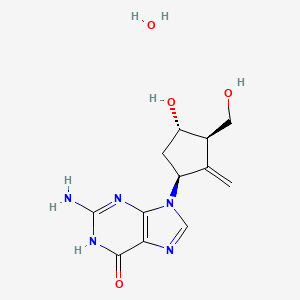
Entecavir 1-Hydrate
USP/EP-grade Entecavir Monohydrate (CAS 209216-23-9), min. 99%, supplied wholesale by Zyntex to licensed producers. Highly potent nucleoside analogue API for low-dose tablets and oral solutions. CoA and SDS with every lot.
Description
Entecavir Monohydrate Product Overview
Entecavir monohydrate (C12H15N5O3·H2O) is a white to off-white crystalline powder that is slightly soluble in water. It is a guanosine analogue and contains about 5–7% water as the monohydrate.
Pharmaceutical companies use it in film-coated tablets and oral solutions for chronic hepatitis B. Tablets contain only 0.5 or 1 mg of API, so content uniformity, particle size control and contained handling are critical. Other antiviral APIs in our range include Valganciclovir Hydrochloride and Remdesivir.
Because it is highly potent, it must be handled in contained systems. Zyntex supplies it from qualified API producers with lot-specific documentation, only to licensed pharmaceutical companies.
Key Applications of Entecavir Monohydrate
Main application areas:
💊 Tablets
API for low-dose film-coated tablets.
🥄 Oral Solutions
API for oral solutions.
🔬 Generic Development
Development and reference material.
🧪 Analytical Use
Reference material for quality control.
Entecavir Monohydrate Technical Specifications
| Parameter | Standard Value |
|---|---|
| Product Name | Entecavir 1-hydrate |
| CAS Number | 209216-23-9 |
| Molecular Formula / Weight | C12H15N5O3·H2O / 295.29 g/mol |
| Purity | Ph. Eur. / USP Grade (Min. 99%) |
| Appearance | White to off-white crystalline powder |
| Water Content | 5.0% – 7.0% (Monohydrate) |
| Documents | CoA and SDS with every lot |
⚠️ Safety & Handling: Highly potent pharmacologically active substance, suspected of causing cancer. Handle only in contained systems with suitable respiratory protection, gloves and protective clothing. Store locked, in tightly closed containers in a cool, dry place. Always consult the Safety Data Sheet (SDS) for full classification and handling instructions.
Frequently Asked Questions
Why is content uniformity critical for entecavir?
Tablets contain only 0.5–1 mg of API, so very fine and uniform particle size and careful blending are needed for every tablet to contain the correct dose.
Who can purchase this API?
It is supplied only to pharmaceutical companies holding the licenses required for API purchase and use in their country.
How can I get a price and documents?
Prices depend on quantity, packaging and destination. Contact us with your required volume to receive a quotation together with the CoA and SDS.